

 English
 русский
 Español
 简体中文
简体中文
Camless Spring Machine Vs Traditional Spring Forming Technology Comparison
Industry News-Choosing between different spring forming technologies involves evaluating multiple factors. The Camless Spring Machine represents a departure from cam‑based methods, and understanding the differences helps manufacturers make informed decisions.
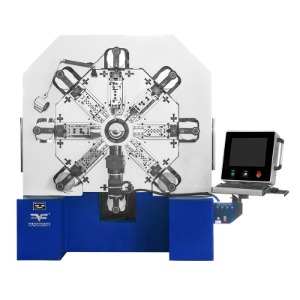
Control and Drive Mechanisms
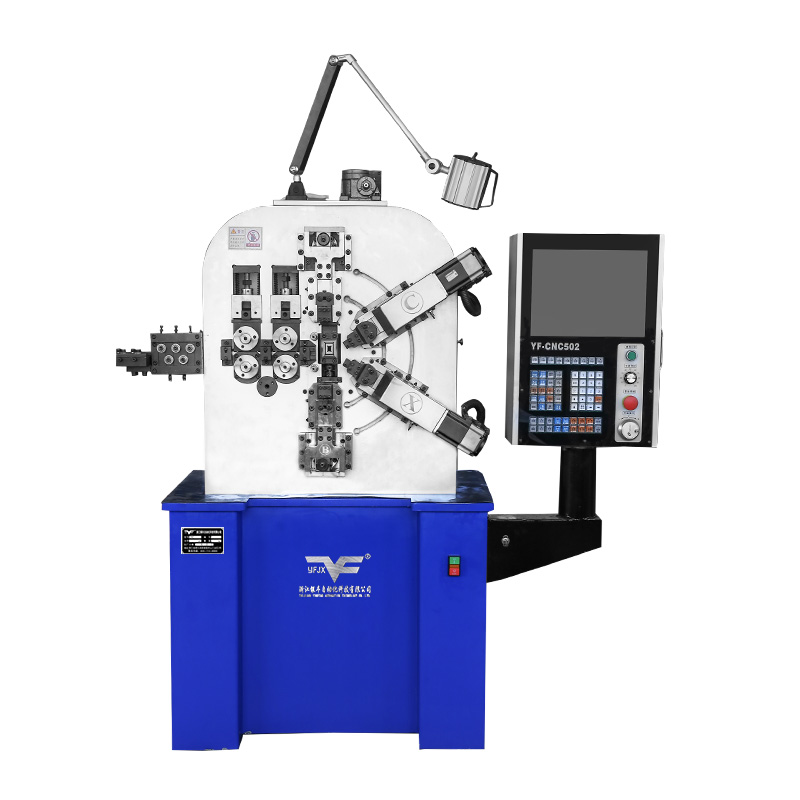
Traditional spring formers use a main motor to drive a camshaft. Cams mounted on this shaft push levers and slides that form the wire. All movements are mechanically linked, meaning the timing of each action is fixed by the cam profile. Changing the sequence requires replacing cams. In contrast, the camless approach uses separate servo motors for each forming axis. A computer sends signals to each motor, and the axes move independently. The timing and sequence are stored in software, not in metal shapes.
Changeover and Setup
On a conventional machine, changing from one spring to another involves removing the existing cam set, selecting new cams from inventory or machining them, mounting them, and adjusting stops and guides. This process can take from half a day to several days for complex springs. On a servo‑driven system, the operator loads a different program file. Tooling positions may need small adjustments, but the core motion profiles are already defined. Changeover times often drop to under an hour, and for simpler springs, under fifteen minutes.
Range of Spring Geometries
Cam machines perform well on standard compression springs, extension springs, and simple torsion springs. However, producing variable pitch, variable diameter, or springs with multiple bends in different planes is challenging because each new feature requires a dedicated cam. The programmable system handles these complex shapes through multi‑axis coordinated motion. Operators can create asymmetric forms, springs with hooks in different orientations, and three‑dimensional wire forms without additional mechanical parts.
Operator Skill Profile
A traditional cam machine demands knowledge of cam design, cam grinding, and mechanical setup. Experienced technicians are not always available, and their training takes years. A camless machine shifts the skill requirement toward programming and digital modeling. Operators need to understand the forming sequence, tooling setup, and software parameters. While this still requires training, the learning curve is often shorter, and more people can be trained within a reasonable time.
Long‑Term Cost Structure
The initial purchase price of a cam machine is typically lower. However, the ongoing costs include cam storage, cam wear and replacement, longer changeover times, and higher scrap during setup. The servo‑driven machine has a higher upfront cost but reduces or eliminates cam expenses. Faster changeovers mean less idle time. Lower scrap during setup saves material. Over several years of use, the total cost of ownership for the camless option can be lower, especially for shops that run many different spring types.
Precision and Stability
Cam machines are subject to wear on cam surfaces, bearings, and linkages. As components wear, the forming accuracy drifts. Regular maintenance and periodic re‑adjustment are necessary. Servo axes use closed‑loop feedback, so they maintain position accuracy even as mechanical components age. The controller continuously corrects small errors. This results in more stable long‑run production and fewer surprises in part dimensions.
Suitability for Different Production Environments
High‑volume, low‑mix production of a single spring type for years may still favor cam machines, as the changeover disadvantage rarely appears. For shops with frequent design changes, many part numbers, or low‑volume orders, the camless machine offers clear advantages. Many modern manufacturing environments fall into the latter category. The trend toward customization and shorter product life cycles has increased interest in programmable forming equipment.
Our Products //
Related Products

Copyright © Zhejiang Yinfeng Automation Technology Co., Ltd. All Rights Reserved. 
Sale Automatic Spring Making Machine