

 English
 русский
 Español
 简体中文
简体中文
Key Applications Of Camless Spring Machine In Automotive Manufacturing
Industry News-The automotive industry demands springs that perform reliably under harsh conditions. At the same time, vehicle models proliferate, and production volumes vary. These factors create a strong need for flexible yet precise spring forming equipment. The Camless Spring Machine has found multiple applications in automotive manufacturing, from engine components to interior mechanisms.
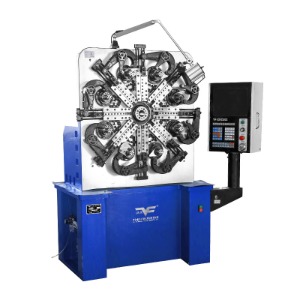
Engine and Valve Train Springs
Valve springs must maintain consistent tension over millions of cycles. Any variation in coil spacing or wire diameter can affect engine performance. Traditional cam formers can produce these springs, but they struggle when design changes occur frequently. With a programmable system, engineers can adjust spring dimensions quickly during development. Once the design is finalized, the same machine can run high‑volume production with reliable repeatability. The ability to store many programs for different engine families is a practical advantage.
Suspension and Chassis Components
Modern vehicles use a variety of spring shapes in their suspension systems. Helper springs, progressive rate springs, and even non‑circular wire forms appear in many designs. These shapes are difficult to produce on cam‑based equipment because each unique shape requires a dedicated cam set. The servo‑driven alternative handles variable pitch, variable diameter, and irregular end configurations through software changes. This flexibility allows suspension designers to experiment with novel geometries without waiting for new cam tooling.
Interior and Seat Mechanisms
Seat adjusters, recline mechanisms, and latch systems contain many small torsion springs and wire forms. These parts often come in dozens of variations within a single vehicle model. Traditional production methods would require storing many cam sets and spending significant time on changeovers. A camless machine can switch between different seat spring programs in minutes. This capability supports just‑in‑time delivery to seat assembly lines, reducing the need for large component inventories.
Fuel System and Brake Components
Fuel injectors and brake systems use precision springs with tight tolerances. Even small deviations in spring rate can alter fluid flow or pressure response. The closed‑loop control offered by servo‑driven formers helps meet these demanding specifications. Furthermore, the ability to adjust forming parameters in response to wire material variations ensures that the final spring matches the required force characteristics. For safety‑related applications, this consistency is critical.
High‑Voltage Connectors in Electric Vehicles
Electric vehicles introduce new types of spring contacts and terminal clips. These parts often have complex three‑dimensional shapes that combine bending, twisting, and coining. Conventional cam machines cannot easily produce such geometries because the forming sequence requires multiple axes to move in coordinated patterns. The multi‑axis programmability of the camless approach makes it possible to form these intricate parts in one continuous process. As electric vehicle production grows, this application becomes increasingly important.
Prototyping and Pre‑Production Runs
Automotive suppliers frequently receive requests for prototype springs with short times. Manufacturing a custom cam set for a prototype is impractical due to cost and time. The camless machine allows a prototype to be produced directly from a digital model. Engineers can test the spring in a vehicle, make adjustments to the program, and produce a revised batch within hours. This rapid iteration cycle accelerates product development and reduces the risk of design errors.
Supporting Mixed‑Model Production
Many automotive plants now build multiple vehicle models on the same assembly line. This approach requires component suppliers to deliver parts in mixed sequences. A camless machine’s quick changeover capability makes it possible to produce different spring types in the same shift without building large buffers. Suppliers can synchronize their spring production with the assembly line’s demand, lowering inventory costs and improving responsiveness.
Our Products //
Related Products

Copyright © Zhejiang Yinfeng Automation Technology Co., Ltd. All Rights Reserved. 
Sale Automatic Spring Making Machine