

 English
 русский
 Español
 简体中文
简体中文
How Camless Spring Machine Improves Precision And Production Efficiency
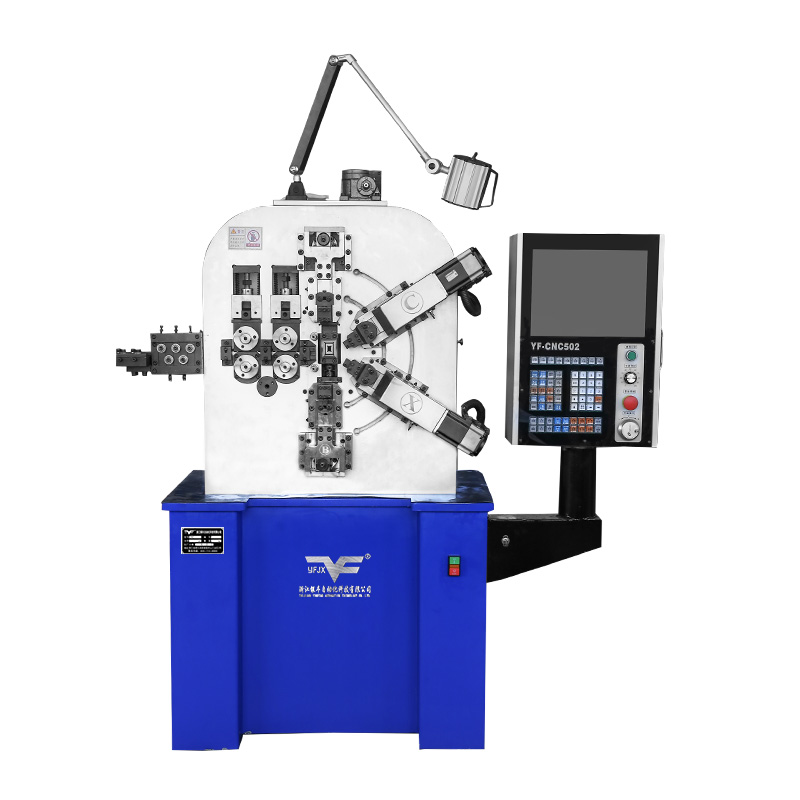
Industry News-Precision and efficiency are often seen as trade‑offs in metal forming. Yet recent developments in servo technology allow equipment to advance on both fronts simultaneously. One such development is the Camless Spring Machine, which uses independent axis control to achieve consistent accuracy while maintaining high output rates.
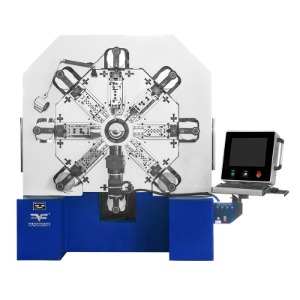
Sources of Dimensional Variation in Conventional Forming
Traditional spring formers rely on mechanical cams that wear over time. As a cam surface erodes, the timing and stroke of each forming tool change slightly. Temperature variations and lubrication inconsistencies add further variability. Operators may compensate by adjusting other parameters, but the process remains susceptible to drift. Over a long production run, spring dimensions can shift noticeably, resulting in rejected parts or the need for manual sorting.
Closed‑Loop Servo Feedback
The alternative approach equips each axis with a servo motor and an encoder. The encoder continuously reports the actual position of the axis back to the controller. If the measured position deviates from the commanded position, the controller applies a correction in real time. This closed‑loop arrangement keeps each movement within a tight window of error, regardless of mechanical wear or external disturbances. The result is a forming process that repeats the same action thousands of times with little variation.
Simultaneous Multi‑Axis Motion
Conventional machines often perform operations sequentially because mechanical linkages limit simultaneous movement. Servo‑driven systems can move multiple axes at the same time. For example, while the wire is being fed, the pitch tool and the forming slide can already be positioning themselves for the next bend. This overlap reduces cycle time without sacrificing accuracy. The machine does not need to pause between steps, so the overall production rate increases.
Programmable Compensation for Material Variations
Wire material properties can vary between batches. Hardness, surface finish, and coil set all affect how a spring forms. A cam‑based machine has fixed motions that cannot adapt to these variations. In contrast, a programmable system allows the operator to adjust feed length, bend angle, or pitch on the fly. Some controllers even incorporate simple feedback from a sensor or a vision system. By compensating for material differences, the machine maintains dimensional consistency across different wire lots.
Consistency Across Long Runs
Because servo axes do not suffer from progressive wear in the same way as cams, the precision of the part closely matches the precision of the ten‑thousandth part. This consistency reduces the need for frequent inspections and recalibrations. Quality control teams can rely on a stable process, which lowers the risk of shipping non‑conforming parts. For industries such as automotive or medical device manufacturing, this level of repeatability is highly valued.
Efficiency Gains Beyond Speed
Efficiency is not only about cycles per minute. It also includes uptime, scrap rate, and operator intervention. A machine that produces accurate parts consistently reduces scrap. A machine that changes over quickly reduces idle time. A machine that requires fewer adjustments during a run reduces operator workload. The servo‑driven design improves all these aspects, resulting in a more efficient overall operation. Workshops that adopt this technology often see a notable increase in their effective capacity without adding extra shifts.
Balancing Initial Investment with Long‑Term Returns
The purchase price of a servo‑controlled former is typically higher than that of a basic cam machine. However, the combination of better precision, less scrap, faster changeovers, and lower skill requirements often leads to a favorable return over the equipment’s life. Manufacturers should evaluate their product mix, batch sizes, and quality requirements when considering this technology. For many, the precision and efficiency benefits justify the transition.
Our Products //
Related Products

Copyright © Zhejiang Yinfeng Automation Technology Co., Ltd. All Rights Reserved. 
Sale Automatic Spring Making Machine