

 English
 русский
 Español
 简体中文
简体中文
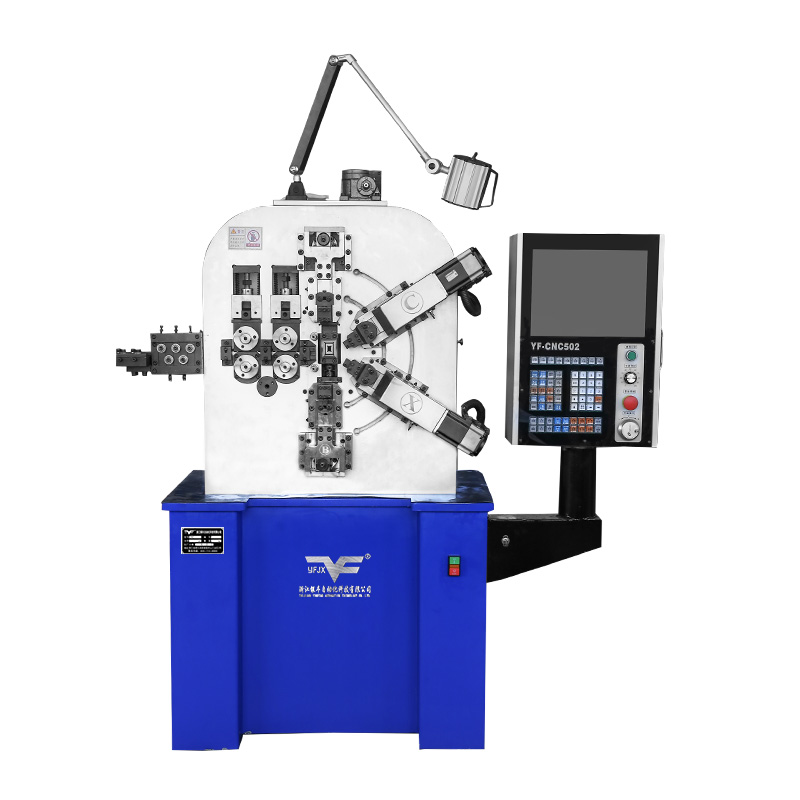
Complex Springs Become Simple Now with a Camless Spring Machine
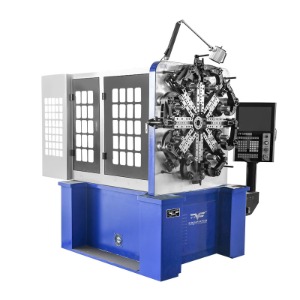
Industry News-Some spring shapes have traditionally been considered difficult or impossible to form on automatic equipment. Double torsion springs, springs with varying pitch in three sections, and wire forms that bend in multiple planes often required secondary operations or manual work. The Camless Spring Machine changes this situation by allowing programmers to define complex tool paths without physical cam restrictions.
Defining Geometric Complexity
A complex spring might include a closed end, a variable pitch section, a reduced diameter segment, and a hook bent at an unusual angle. Another example is a double torsion spring with two coils wound in opposite directions from a common center leg. Traditional cam machines struggle with these features because each forming action must be timed precisely relative to others, and the cam profiles become extremely intricate. Many shops simply refused such orders or quoted very high prices.
How Multi‑Axis Programming Handles Complexity
The servo‑driven system treats each forming axis as an independent actor that can move at any speed and any position within its range. The programmer writes a sequence of coordinated moves. For a double torsion spring, the machine can wind the one section in one direction, pause, reverse the rotation direction, and wind the second section. The pitch tool can move forward or backward during the winding to create a variable pitch. All of this is defined in software, not limited by the shape of a rotating cam.
From CAD Model to Formed Part
In a typical workflow for a complex wire form, the designer creates a three‑dimensional model. The programmer imports the model or manually enters coordinates. The control software calculates the required axis movements. The operator loads a coil of wire and runs a test. Adjustments are made by changing numbers on the screen. There is no need to machine a trial cam, test it, find a timing error, and machine another cam. The digital approach compresses the development cycle from weeks to days or even hours.
Eliminating Secondary Operations
Complex springs often require separate bending, twisting, or coining operations after the initial forming. Each secondary operation adds handling time, fixturing cost, and opportunity for dimensional errors. Because the camless machine can move multiple axes in coordinated patterns, many secondary operations can be integrated into the main cycle. The wire is formed into its final shape in one continuous process. This reduces labor, improves consistency, and shortens overall production time.
Enabling New Product Designs
Product engineers sometimes avoid innovative spring geometries because they know the forming equipment cannot produce them. When a shop acquires a programmable former, those constraints change. Engineers can design springs that optimize force distribution, reduce weight, or fit into tight assemblies without worrying about cam feasibility. This freedom leads to better product performance. In sectors such as medical devices, aerospace, and consumer electronics, the ability to create non‑traditional spring shapes provides a competitive edge.
Rapid Iteration for Prototypes
When a complex spring is being developed, the one design rarely works perfectly. The spring rate may be too high, or the hook may interfere with another component. On a cam system, each iteration requires a new cam set, which is slow and expensive. On a programmable system, the operator edits the program and produces a new batch in a short time. This rapid iteration allows development teams to test multiple design variations and converge on a solution faster.
Our Products //
Related Products

Copyright © Zhejiang Yinfeng Automation Technology Co., Ltd. All Rights Reserved. 
Sale Automatic Spring Making Machine